From Orbit to Earth: Why Space Medicine Can Transform Healthcare
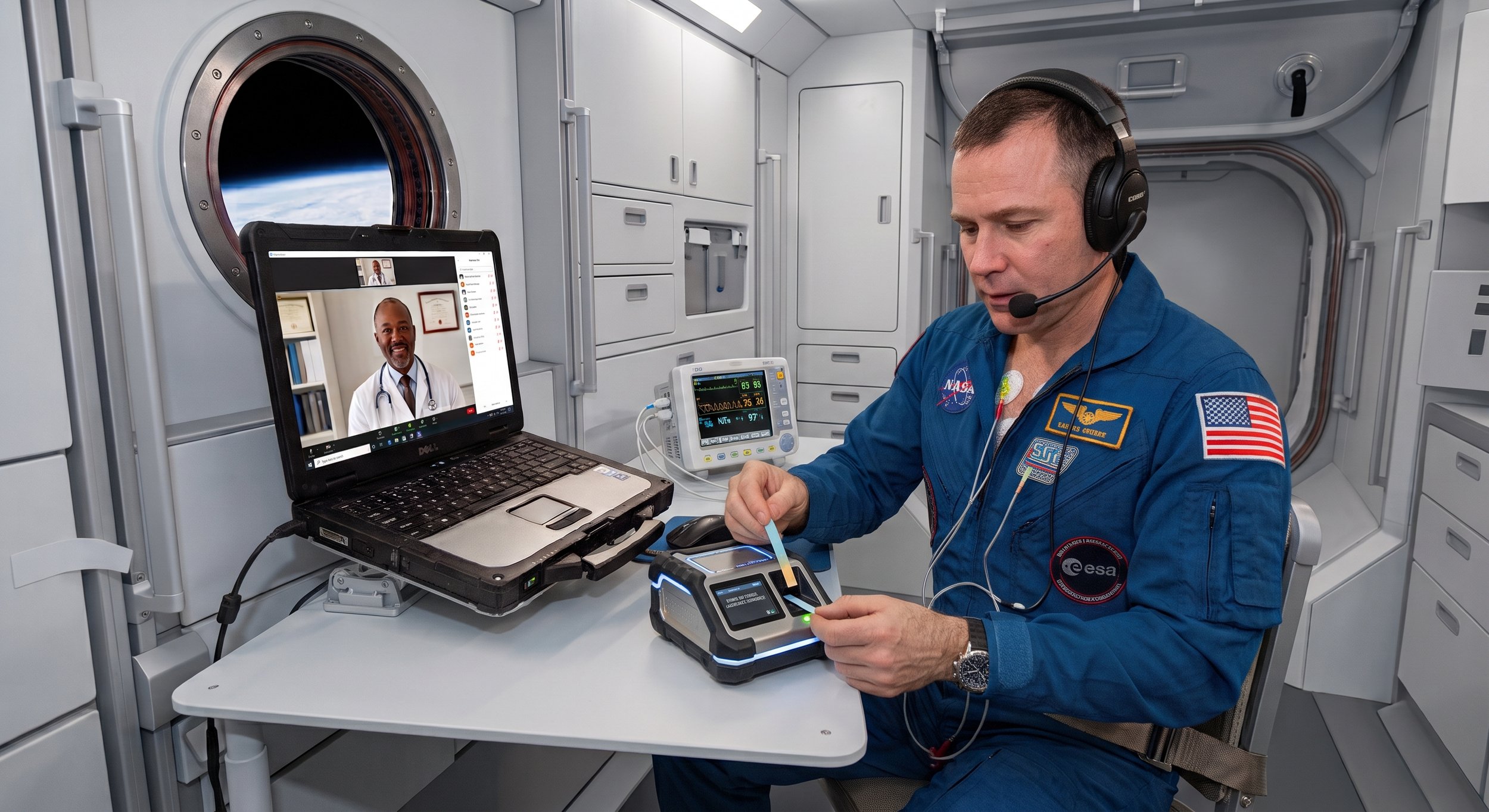
Artists AI generated composition of scientists doing health research in space.
The challenges of space can create opportunities to rethink how healthcare is delivered on Earth.
Space is one of the most demanding environments in which medicine can operate. Medical teams supporting space travelers must think differently about distance, resources, communication, physiology, and time. A physician cannot simply send a patient to the nearest hospital when the patient is hundreds or thousands of miles from Earth.
That constraint creates a powerful opportunity.
The technologies, protocols, and decision-making systems developed for space can potentially address challenges faced by people in remote and resource-limited environments on Earth.
This concept is central to OrbitalMed's vision of what it calls a cross-gravity approach to healthcare.
Medicine Without Immediate Access to a Hospital
Many communities and industries on Earth already operate under conditions that can resemble some of the logistical challenges of spaceflight.
Remote communities, maritime operations, defense environments, disaster-response teams, aviation, and other high-risk industries may require medical decisions to be made far from conventional healthcare infrastructure.
Space medicine offers a unique laboratory for addressing these problems.
OrbitalMed's approach incorporates telemedicine, predictive health analytics, AI-supported diagnostics, and other technologies intended to improve medical decision-making in demanding environments.
The goal is not simply to take existing healthcare into space.
It is to learn from the extreme requirements of space and apply those lessons where they can have broader impact.
A Learning Health System
OrbitalMed's systems approach connects clinical operations with research and policy.
Data and experience from missions can inform research. Research can influence clinical protocols. Clinical experience can identify new technology requirements. And policy can help establish standards that allow those systems to operate safely and consistently.
This creates a continuous feedback loop.
Every mission can become an opportunity to learn more about human performance, health, adaptation, and resilience.
That knowledge can then support future missions — and potentially contribute to healthcare innovation on Earth.
Research Designed for Real-World Impact
OrbitalMed's research and innovation activities are focused on areas including radiation exposure, isolation, microgravity, stress physiology, telemedicine, AI diagnostics, predictive health analytics, and potential countermeasures for the challenges of spaceflight.
These are not challenges limited to astronauts.
Understanding how humans respond to isolation, stress, changing environments, limited resources, and physiological extremes can provide insight into healthcare beyond traditional clinical settings.
The opportunity is therefore two-directional.
Earth informs space. Space informs Earth.
The Broader Vision
OrbitalMed was founded by physicians and former NASA astronauts who have experienced the demands of human spaceflight firsthand. Its leadership combines experience in medicine, aerospace, aviation medicine, telehealth, research, and strategic operations.
That perspective shapes a broader vision for space medicine — one that views the space environment not only as a destination, but also as a catalyst for innovation.
As humanity pushes farther beyond Earth, the medical challenges will become more complex.
Meeting those challenges could produce something equally valuable here at home: new ways to deliver healthcare when distance, resources, and conventional infrastructure are no longer enough.
The next generation of healthcare may be shaped not only by what we learn on Earth, but by what we learn beyond it.